Posts

5 changes in consumer-brand relationships

The advent of social media and the diffusion of digital technology have created significant changes in the way  consumer-brand relationships  are conceived, both by consumers and by companies. This pst discusses some of the major factors that have contributed to this evolution. 1. Personal vs. public conversations A few decades ago, interactions between consumers and companies were rare and occurred almost entirely in a  one-to-one manner . Consumers had few available options for retrieving information from a company as  communication channels were limited ; they could perhaps contact a call center, drive to a store, and, more recently, write an email.  Interactions between companies (or intermediaries) and consumers were usually private . Some recurring issues might have cost companies a lot of money as they needed to be addressed to different customers over and over again. Also, badly handled interactions would have had  limited consequences for a...

Brand Ideals: connecting content strategy to relational strategy and brand strategy

Image
According to Stengel (2011),  brand managers should be conceived as “business artists” , leaders whose primary medium is brand ideals.  The scope of these business artists is to  discover (or rediscover) a brand ideal  in one of the five fields of fundamental human values, to  build a business culture  around the ideal, to  communicate the ideal  across the organization and outside of it, to  deliver a near-ideal customer experience , and to evaluate business performance  against this ideal.  Once a brand manager is clear on the brand ideals (that is, what the brand stands for), the next step is to  create communication assets (and a campaign) to guarantee customer experience that supports the chosen ideal  that will drive the business.  An example is how  Coca-Cola , which has long been associated with happiness, has transformed for a  recent partnership with the James Bond movie “Skyfall”  ...

Brand Ideals definition: first step in your Branding Strategy

Image
Marketing and corporate communications managers are often confronted with the need to anticipate market trends. In order to be at the cutting edge of innovation, they are often willing to  adopt technology that can generate visibility and a sense of innovativeness , despite the value delivered to consumers can be objected.  Too often, a marketing goal becomes to  distribute brand messages across the globe in the fastest and cheapest way .  This leads to the  communication idea and the technological tools being chosen over the brand strategy . In other words, the  communication campaign becomes a mere tactic with no (or even negative) long-term business implications .  At the very core of a content strategy, marketing managers should always focus their brand strategy on brand ideals .  A  brand ideal is the higher purpose of a brand or organization , which goes beyond the product and the service it sells (WPP, 2012). ...

Social Media ROI to measure relationship quality? No, thanks

Image
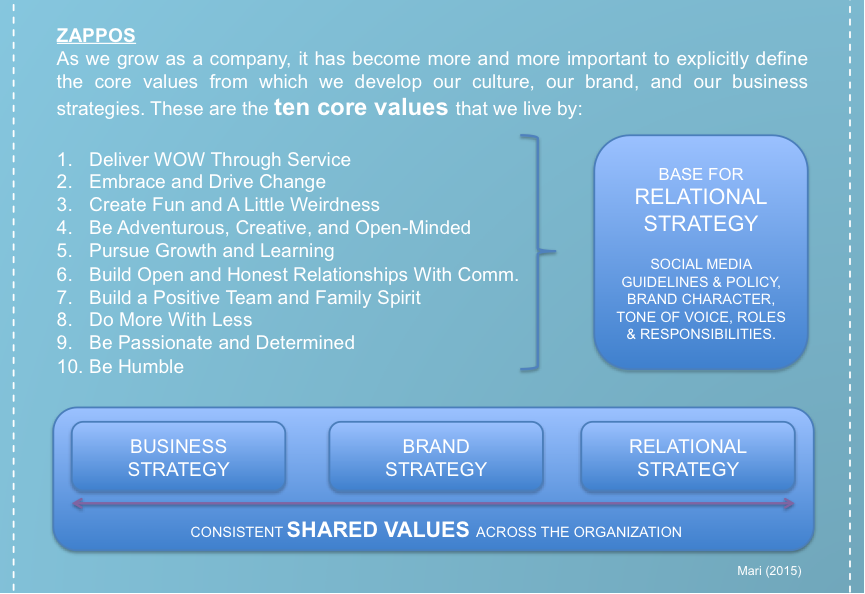
One of the major challenges for companies is to guarantee  continuity of the relationship development process . Since priorities in companies can change quickly, while the relationships takes time to evolve, it is not uncommon to observe a dramatic change in the online communication efforts of a brand, due to a lack of resources or interest by the top management.  In every company, people, priorities, and the availability of resources change so frequently that the  plan of building strong long-term connections can fall at any point .  One way to prevent this is to include a  consumer-centric strategy inside the overall company vision . Zappos.com, an online shoes and clothing shop acquired by Amazon, is a great example of such an approach. Zappos employees are encouraged to  go above and beyond traditional customer service . For example, when a woman called Zappos to return a pair of boots for her husband because he had died in a car accident, she r...

Facebook Fans vs. Brand Lovers

Image
The non-realization by brand managers that consumers engagement is something they should be aiming at ONLY after the user knows the brand, has considered its values and benefits, has tried the product and have shown certain level of interest to it, makes the  online communication particularly ineffective .  Consider the example of an advertisement regarding a contest run by a new beauty product that offers tickets to events for those who share details of their beauty routine. This contest should, first of all, consider the consumer’s level of familiarity with the presented brand.  What stage of the relationship development process is the consumer at?  The best way to initiate a relationship is usually introduce yourself, show your personality and values, and make clear what you can offer (that is, the “benefits”).  Whenever a brand adopts a  direct approach to engage with users  that have zero familiarity with its products, there is a very...